Case study · Inventory Connect MCP & agent-ready commerce

Your stock is only as good as the last feed. Let AI ask the source.

Most sellers share inventory with partners through custom integrations and nightly files. They are slow to build, they go stale between updates, and most were never designed for AI shopping assistants. CrossDigital Solutions designed Inventory Connect MCP: one secure connection that lets AI assistants and partner apps search products, check live stock, hold items and place orders, with the business in control of every partner.

Partner listings · 14:02Nightly feed

Type
Product concept (not yet built)
Designed by
CrossDigital Solutions
Scope
Product strategy, MCP tool design, system architecture, roadmap
Status
Architecture + 18-week plan, Oct 2026
01 · The problem

One integration per partner, and stock numbers that are already old

A typical seller connects each partner separately: a custom API for one marketplace, a CSV or EDI file for another. Each connection takes weeks to build and keeps needing attention after launch. Access is usually all or nothing, because a partner's API key opens everything.

Between updates, the numbers drift. A marketplace shows stock that sold an hour ago, the order goes through, and someone has to cancel it and apologize to the customer.

Problem statement

Partners and AI assistants sell from stock data that is hours old, through integrations that each take weeks to build. The seller can't easily limit what each partner sees or does.

How might we

give every partner and AI assistant live, trustworthy stock and a safe way to hold and order it, through one connection, without the seller giving up control?

partner-marketplace.com/item/RUN-BLK-10

Trail running shoe · black · size 10

In stock4 availablestock file from 02:00

Pickup today at Miami store MIA-01.

The partner shows what last night's file said.
02 · Four gaps in how stock is shared today

Slow to connect, stale once connected, and hard to control

G1 · Integration cost

One build per partner

Each new channel means a custom API project or a file feed, plus maintenance after launch. Most were never designed for AI assistants.

Seller question it can't answer: "Can a new marketplace be selling our stock next week instead of next quarter?"

G2 · Stale stock

The feed is a snapshot

Files and batch syncs run on a schedule. Anything sold in between still shows as available, and nothing holds the last unit while a shopper decides.

Shopper question it can't answer: "Is this actually in stock right now, near me?"

G3 · All-or-nothing access

One key opens everything

There's no simple way to give one partner read-only access, cap how much it can hold, or switch it off without affecting the others.

Seller question it can't answer: "Can this partner see stock but not place orders, and can I cut them off in one click?"

G4
Constraint, and the design principle that follows

We don't control the partner's app or the AI model. We do control what they can see, what they can do and what they can promise.

AI assistants will misread requests and retry calls. The server has to assume that and stay correct anyway: prices calculated on the server, holds that can't double-sell, and limits for each partner.

Why this matters now: in 2026 the large platforms settled on open protocols for agent shopping. Shopify and Google back UCP, and OpenAI and Stripe back ACP. But checkout inside the chat stalled.[4] [6] [7] Agents find the product, and the purchase often finishes somewhere else. That makes a live stock answer, and a hold that survives the hand-off, more important. Both belong to the seller's own systems, not to any one AI platform.

03 · Competitive teardown

The big players standardize the front door. Nobody publishes how the last unit is held.

Channel-management tools keep stock in sync across marketplaces. The new agent-commerce standards define how an AI agent talks to a merchant. In the public material we could find, none describes holding stock for an agent while a shopper decides, or splitting stock between agent partners. Facts are cited below. Assessments are ours, as of October 2026.

Rithum

multi-channel commerce platform (formerly ChannelAdvisor)
Does well
Markets "real-time inventory syncing" across warehouses and stores, and LLM Feeds that deliver structured product data to AI platforms such as ChatGPT, Perplexity and Gemini.[1]
Breaks
Its agentic offer is built around feeds: product data pushed to AI platforms, which then answer from that copy. The page doesn't mention MCP, stock holds for agents or per-agent permissions.[1]
We do instead
Let the agent ask the source when it matters, and hold the unit while the shopper decides.

Linnworks

inventory and order management for marketplace sellers
Does well
Connects 100+ marketplaces and channels from one stock count, with preventing oversells at the center of its pitch.[2]
Breaks
The same page says stock "syncs across every channel every 5–15 minutes" while also promising real-time sync and "zero oversells".[2] On a fast-selling last unit, that window is the gap. Its only AI reference is workflow automation. We found no official agent access. Third parties sell MCP connectors for it, aimed at the seller's own operations.[3]
We do instead
Cache stock for no more than 30 seconds, check the source on every hold or order, and expose it directly to AI agents.

Shopify

commerce platform · Catalog API + UCP
Does well
The most complete agent stack we found. Catalog API makes Shopify's global product catalog queryable by AI agents with an API key. UCP, co-developed with Google, covers discovery, carts and checkout, and developers can subscribe to inventory-update webhooks.[4]
Breaks
It's built for products sold on Shopify.[4] A wholesaler whose stock lives in an ERP or warehouse system has to sync it into Shopify first, and that brings the feed lag back. The announcement doesn't describe stock holds or partner-level allocation for agents.[4]
We do instead
Sit in front of the systems where stock already lives, whatever the storefront.

OpenAI

AI assistant · Agentic Commerce Protocol
Does well
An open protocol, co-developed with Stripe, connecting ChatGPT users to merchants. The merchant validates each order, handles tax and payment, and accepts or declines it.[5]
Breaks
Product discovery runs on a "regularly refreshed feed (CSV or JSON)" with daily snapshots, and the docs don't mention inventory holds.[5] In March 2026, OpenAI moved Instant Checkout out of ChatGPT and into merchant apps, reportedly because few merchants used it and shoppers researched in ChatGPT but bought elsewhere.[6]
We do instead
Give the agent a live answer, and a hold it can carry into whichever checkout the shopper uses.

Google

search and AI surfaces · UCP-powered checkout
Does well
UCP is an open standard for agents and business systems to work together, and the merchant stays the merchant of record when checkout happens on Google.[7]
Breaks
Checkout is "available for select merchants at this time", for products eligible in the U.S., Canada and Australia, and only on listings with a specific product attribute. Merchants also need a Google Pay & Wallet Console account. The help page doesn't describe how stock is held during checkout.[7]
We do instead
Work with any MCP-compatible agent, with stock, holds and limits controlled by the seller.
GapRithumLinnworksShopifyOpenAI ACPGoogle UCPInventory Connect (concept)
G1 One connection for AI agentsLLM feeds to AI platformsThird-party connectors onlyCatalog API + UCP, Shopify catalogProtocol + product feedProtocol, select merchantsAny MCP client, any back-end system
G2 Stock freshness"Real-time", no interval published"Every 5–15 minutes"Inventory webhooksRefreshed feed, daily snapshotsNot described≤ 30 s, refreshed on change, timestamped
G2 Holds while the shopper decidesNot describedNot describedNot describedNot describedNot describedTimed holds, no double-selling
G3 Per-partner limits and stock splitChannel-level toolsChannel-level toolsNot described for agentsMerchant accepts or declines each orderMerchant of recordScopes, caps, allocation and kill switch per partner

"Not described" means we found nothing in the cited public pages, not that the feature can't exist. These platforms have deeper developer documentation, and they change often.

04 · User journey

From "running shoes, size 10, pickup today" to a confirmed order

The shopper, the seller and the gap behind each failure, side by side. Pick a stage.

05 · The solution

Five capabilities, one connection

Each one closes a gap. The AI assistant handles the conversation. The server handles everything that has to be correct.

G1

One standard connection

Partners connect once over MCP with OAuth sign-in instead of a custom build. A sandbox and tool playground let them test before going live.

AI roleDiscovers the tools and their inputs on its own.
G2

Live availability

On hand, minus held, minus safety stock. Cached for no more than 30 seconds, refreshed when stock changes, and every answer carries an "as of" time.

AI roleChecks before it recommends, and knows how fresh the answer is.
G2

Timed stock holds

Holds last 15 minutes by default and expire on their own. Two assistants can't hold the same last unit.

AI roleHolds the item while the shopper decides, then confirms or releases it.
G3

Per-partner control

Scopes (read, hold, order), quantity caps, request limits and a stock allocation for each partner, managed in an admin console with a kill switch.

AI roleNone. These rules belong to people.
G3

Safe orders, full record

Large orders wait for human approval. A retried request never creates a second order. Every call is logged with personal data removed.

AI roleGets clear errors with a suggested next step instead of guessing.
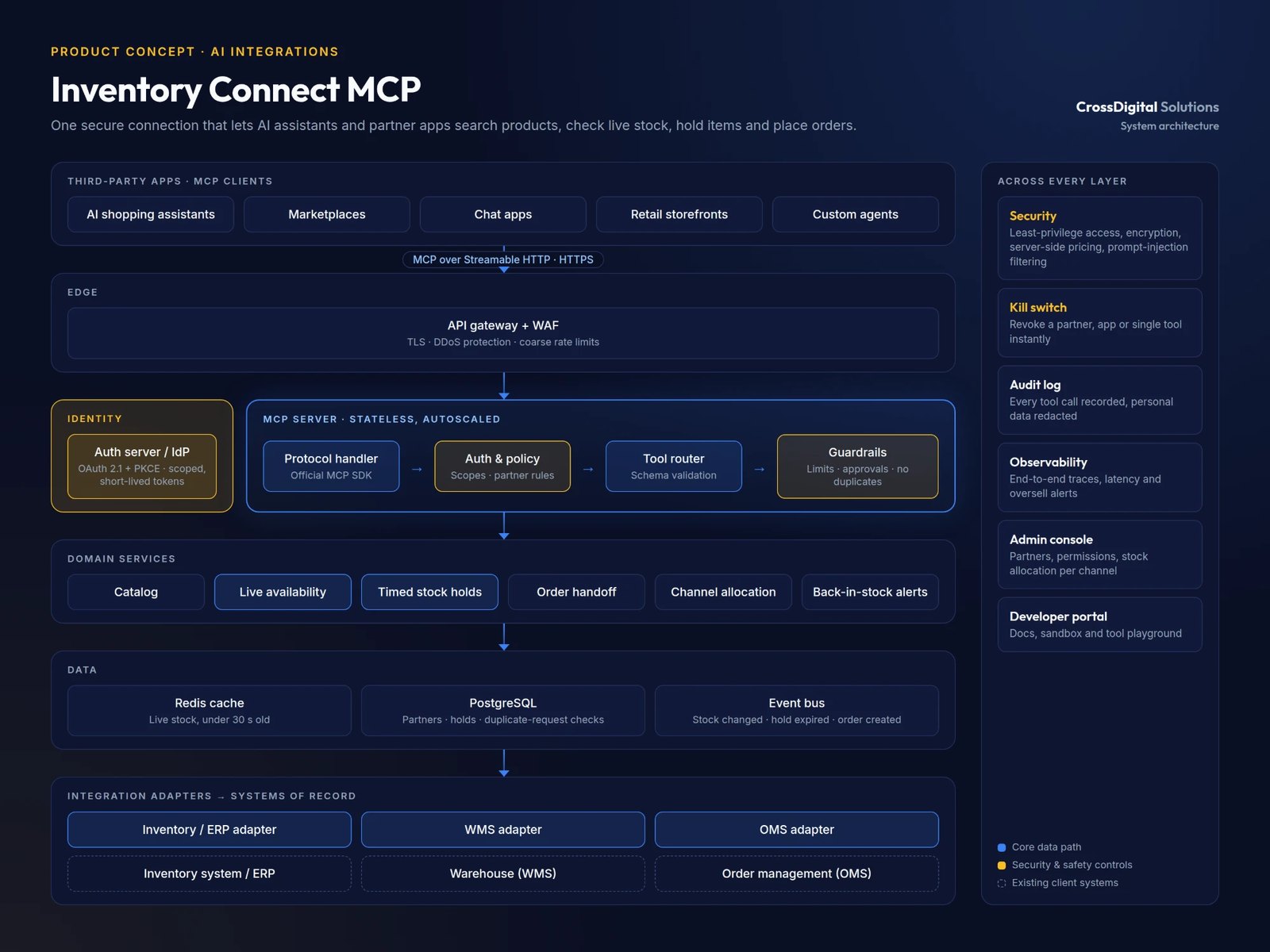
Architecture diagram of Inventory Connect MCP. Partner apps and AI assistants connect through an API gateway to an MCP server that checks identity, permissions and safety limits, then calls catalog, live stock, stock hold and order services that link to the business's existing inventory, warehouse and order systems.
System architecture. Stock changes, expired holds and new orders flow back as events that refresh the cache. The inventory system stays the system of record.
06 · Try it

The last-unit test: many agents, a few units

AI assistants arrive over an hour and ask for the same item. On the left, they read a stock file. On the right, they ask Inventory Connect and hold before they buy. Change the numbers and see who gets disappointed, and when. Everything is illustrative and calculated in your browser.

Test setup
The rest only check availability and move on.
Stock file, 02:00G2 today

orders cancelled after checkout

Inventory Connectlive + holds

orders cancelled after checkout

What an assistant sees when it's too late


Illustrative model. Arrival and decision times are random, and a quarter of shoppers who pick the item change their mind. Only shoppers who pick the item take a hold, and holds are granted one at a time, as the design's locked update would do. The default of 500 assistants and 10 units mirrors the concurrency test planned for the private beta, which has not been run.

07 · Wireframes

Four screens: control, split, test, review

Three screens for the business and one for partner developers. Hover a note to find it on the frame.

    08 · Guardrails

    Rules written before any assistant touches stock

    AI assistants misread, retry and sometimes follow text they shouldn't. These rules keep the stock count right anyway.

    rule: the server sets the price

    Prices never come from the agent

    Prices and totals are always calculated on the server. A price supplied by an assistant is never accepted.

    rule: holds can't double-sell

    One last unit, one hold

    Holds are taken in one locked step, so two assistants can never claim the same last unit.

    rule: retries are safe

    Same request, same result

    Every write carries a unique key. Sending the same request twice returns the first result instead of a second order.

    rule: big orders wait for a person

    Human approval above a set value

    Orders above a threshold the seller sets need a person to confirm them before they go through.

    rule: data, not instructions

    Product text can't steer the agent

    Catalog text is cleaned before it's returned, and responses never carry instructions an assistant could follow.

    rule: every partner has an off switch

    Revoke in one click, log everything

    A partner, an app or a single tool can be revoked instantly, and every call is logged with personal data removed.

    Official MCP SDKOAuth 2.1 + PKCEPostgreSQL (holds, retry keys)Redis (live stock cache)Event busOpenTelemetryERP / WMS / OMS adaptersAdmin console + developer portal

    Your partners will keep asking for stock. Give them the real number.

    We design inventory connections, MCP servers and AI features for wholesale, retail and multi-channel businesses. We start with the systems you already use.

    Talk to CrossDigital Solutions → Websites, CRM integrations and AI products for small teams.
    Sources for the teardown
    1. Rithum, "Your path to profitable, AI ready commerce starts here." rithum.com
    2. Linnworks, "Inventory management." linnworks.com
    3. Truto, "Connect Linnworks to Claude: sync stocks and sales channel listings" (third-party connector vendor), 2026. truto.one
    4. Shopify, "Agentic commerce for every developer: The Spring '26 Edition," June 17, 2026. shopify.com
    5. OpenAI, "Agentic Commerce Protocol: Key concepts." developers.openai.com
    6. Digital Commerce 360, "OpenAI shifts checkout plans in its agentic commerce strategy," March 6, 2026. digitalcommerce360.com · Search Engine Land, "OpenAI's big ChatGPT Instant Checkout plan just changed." searchengineland.com
    7. Google Merchant Center Help, "About the Universal Commerce Protocol (UCP) and UCP-powered checkout feature on Google." support.google.com

    Product concept. The architecture, tool names and targets come from the design brief, and none has been tested in production. Demo stock levels, arrival times and results are illustrative. Company names are trademarks of their owners and are used for comparison only. CrossDigital Solutions is not affiliated with them.

    © 2026 Cross Digital Solutions LLC · Privacy · Terms